 Events
 Podcast
 Columns
 Library
 Contact




Sep 13, 25
Filed under: Editorials, Indigenous, Mexico, Political Prisoners, Solidarity, Southern Mexico

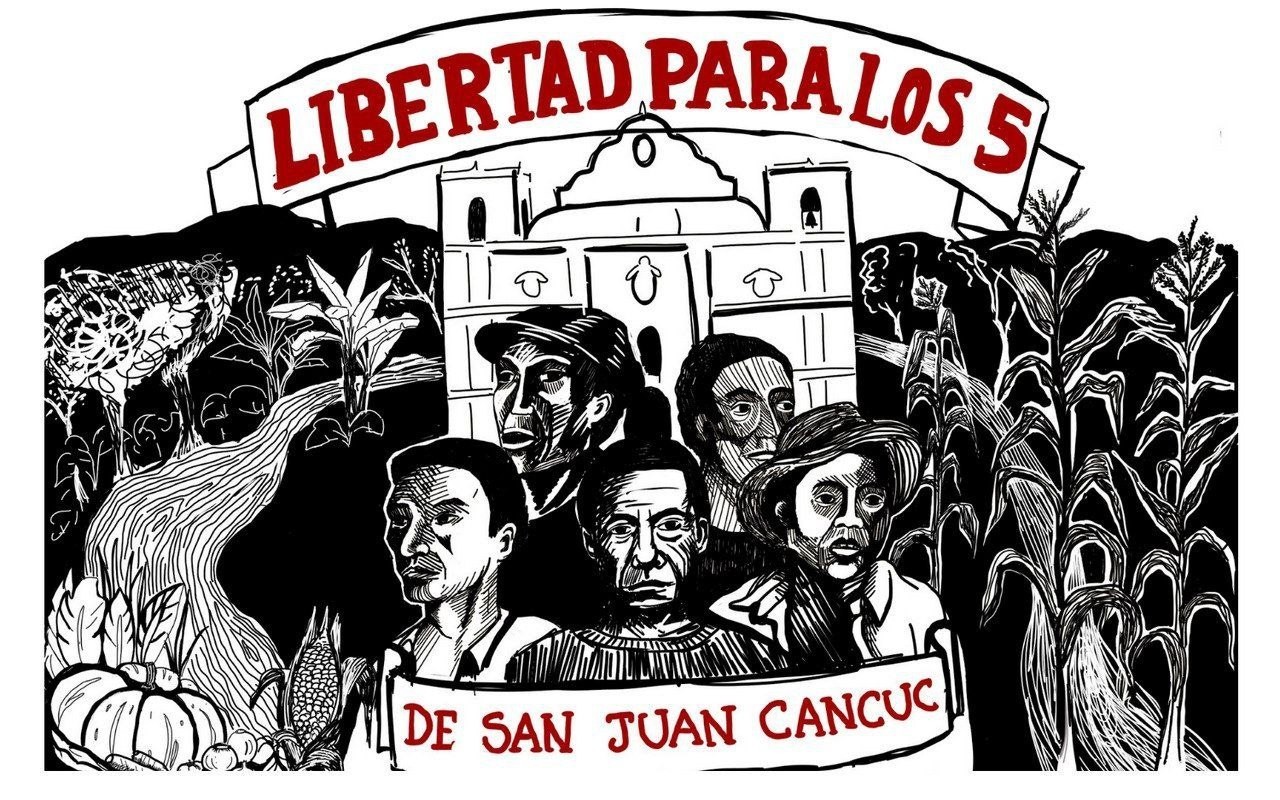
The text below provides an overview of the case of five imprisoned Tzeltal land defenders from San Juan Cancuc, Chiapas, and how they can be supported during a crucial moment in the fight for their freedom.
The Context
San Juan Cancuc is an Indigenous Tzeltal municipality in the highlands of Chiapas located about halfway between the popular tourist destinations of San Cristóbal de Las Casas and the Cascadas de Agua Azul. For more than 20 years, the federal and state governments have been attempting to “develop” the region via the construction of a superhighway, called the Highway of Cultures. This highway would connect the coast of Chiapas in the west – where the Interoceanic Corridor will pass – with the highlands and jungle regions of the east – where they Maya Train will pass. With neoliberal development comes militarization, and attempts have been underway to construct a National Guard base near San Juan Cancuc. Since coming to power in 2018, the MORENA party has accelerated these projects.
The proposed Highway of Cultures is to pass through San Juan Cancuc and the State has put pressure on the municipality to agree to the construction – including withholding social programs. In repeated community assemblies, the residents of the municipality and neighboring communities have rejected both construction of the superhighway and the National Guard base.
The Case
Within this context, at 5 AM on the morning of May 29, 2022, residents of San Juan Cancuc found a municipal police officer drunk and handed him over to other officers. At 10 AM, this officer was found dead on a sidewalk. A few hours later, three of the people who handed the drunk cop over to his colleagues, Manuel Sántiz Cruz, Agustín Pérez Domínguez, and Juan Velasco Aguilar, were arrested for possession of marijuana. Other residents came to testify as to their innocence.
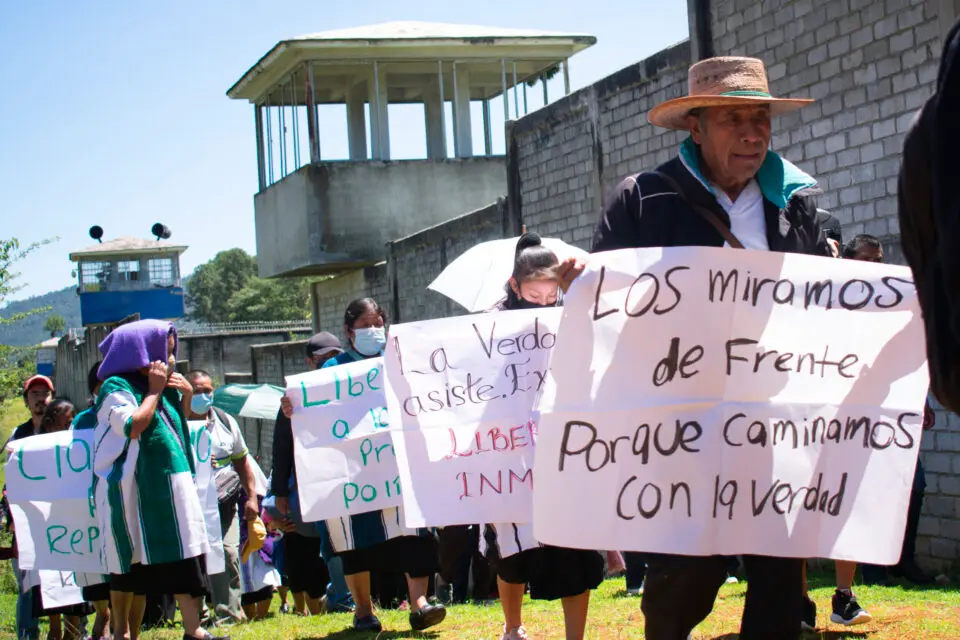
The possession charges against the three were dropped two days later. Yet upon being released, they were immediately arrested again and charged with homicide in the death of the cop. Two people who came to testify in their support were also arrested and charged: Agustín Pérez Velasco and Martín Pérez Domínguez. The state claims the five men kicked the cop to death as his colleagues watched, when in reality, the cop was handed over to other cops and by all indications he was killed by his colleagues. In May 2023, a judge ruled that all five were guilty of homicide and gave each a sentence of 25 years in prison. On appeal, their sentences were reduced to 18.5 years. They are currently held in the State Center for Social Reintegration for Convicts (CERSS) Number 5 in San Cristóbal de Las Casas.
The Politics
The case of the San Juan Cancuc 5 is understood as serving two purposes for the State. One is that it pins the killing of a cop on those who are not also cops, and two, it punishes the community – of which all five are active members – for its opposition to neoliberal development projects.
The United Nations Working Group on Arbitrary Detention on May 15, 2025, issued a report on the San Juan Cancuc 5 that states they were detained for their political work and calls for their immediate release.
The arrests of the five individuals were due to their activism as members of the human rights committee, specifically in a context where State officials are alleged to systematically engage in the criminalization of human rights defenders and defenders of land and territory in Chiapas (7).
The Working Group considers that, taking into account all the circumstances of the case, the appropriate remedy would be to release the five individuals immediately and accord them an enforceable right to compensation and other reparations, in accordance with international law (14).
In a joint statement on July 23, 2025, seven international human rights groups reaffirmed the Working Group’s findings and called for the immediate release of the five:
Furthermore, the Working Group recognizes the five convicted men as human rights defenders and considers that their criminalization is precisely due to their work in defense of land and territory and to the fact that they belong to the Tzeltal ethnic group, discrimination that extends even to their lack of proficiency in Spanish (2).
We request that the authorities of the Mexican State and the state of Chiapas: Comply with the opinion issued by the Working Group on Arbitrary Detention, which translates into the immediate release of Manuel Sántiz Cruz, Juan Velasco Aguilar, Augustín Pérez Domínguez, Agustín Pérez Velasco, and Martín Pérez Domínguez; the investigation of the authorities responsible for their criminalization; and full reparation for all damages caused (4).
In a joint statement on April 18, 2024, multiple human rights groups in Chiapas identified the five as land and human rights defenders and called for their immediate release:
During this lengthy process, which has lasted 22 months and 18 days of arbitrary deprivation of freedom for the five defenders of the Cancuc territory, we have confirmed and demonstrated their innocence, and observed that the fabrication of evidence by the Prosecutor’s Office is a constant.
The criminalization of Indigenous defenders in Chiapas and Mexico is a form of exemplary punishment for defending human rights, land, and territory. It is rooted in structural racism and is carried out through arbitrary deprivation of freedom, torture, and fabrication of guilt. Members of the Mexican Army and National Guard participate in the arrests, in addition to the failure to provide trials with an intercultural perspective, accompanied by excessive use of preventive detention.

Support
The San Juan Cancuc 5 are being accompanied by the abolitionist Grupo de Trabajo No Estamos Todxs. Here’s a statement they released recently regarding their work for the five, as well as an interview with a member [Part 1, Part 2]. The group is attempting to make noise in the lead up to November of this year, when two crucial decisions are scheduled to be made. On the one hand, the court must rule on an amparo filed on behalf of the imprisoned compañeros. An amparo is akin to an injunction arguing that their rights have been violated and they must be freed. Secondly, the Mexican State is treaty-bound to respond to the United Nations call to release the five by the month of November.
Towards that end, the Grupo de Trabajo No Estamos Todxs is selling t-shirts to raise funds for the compañeros, as well as requesting that video messages of solidarity in any language be sent to them by September 22. Below is the call for videos. If you have questions or are interested in a t-shirt, please contact Scott Campbell.
Solidarity video campaign for the freedom of the prisoners from San Juan Cancuc
To all our compañerxs, organizations, and solidarity groups:
For more than three years, five compañeros from San Juan Cancuc have been unjustly imprisoned in CERSS No. 5 in San Cristóbal de las Casas, Chiapas. Their only “crime” has been to be Indigenous and defenders of the land and territory. Despite repeated demonstrations of their innocence, the Mexican state has convicted them in trials riddled with irregularities.
The UN Working Group on Arbitrary Detention has requested that the Mexican government release them immediately and comply with its international human rights obligations.
We therefore call on everyone to participate in the Solidarity Video Campaign by sending a message of support demanding their release.
The video must be in vertical format (30 to 60 seconds) and include the following message:
- “We demand the immediate release of our five imprisoned compañeros from San Juan Cancuc.”
- “Stop the fabrication of guilt!”
- “Comply with the opinion of the UN Working Group on Arbitrary Detention.”
Send your video to: noestamostodxs@riseup.net
We will not rest until our five compañeros regain their freedom.
Sincerely,
Grupo de Trabajo No Estamos Todxs