 Events
 Podcast
 Columns
 Library
 Contact




Aug 14, 25
Filed under: Community Organizing, Education, How To, US

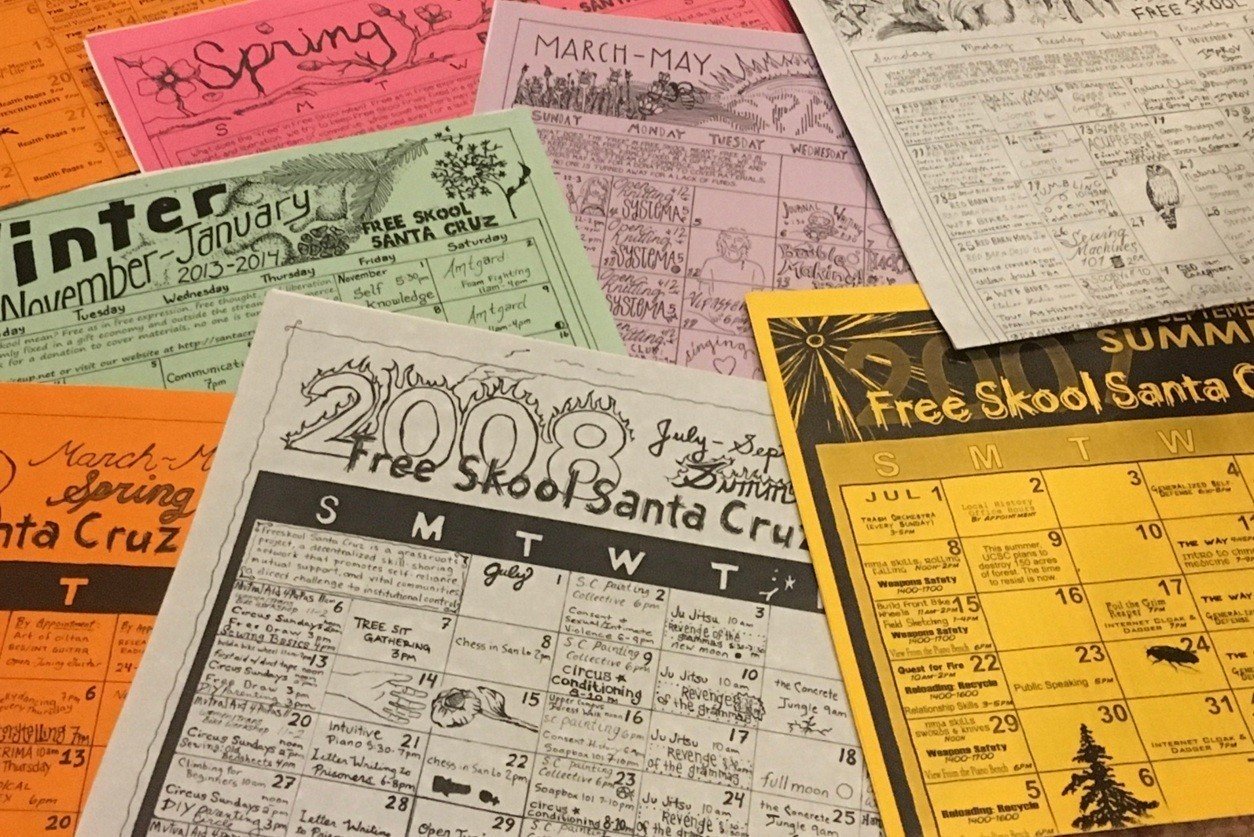
Neighborhood Anarchist Collective looks at Free Skools and how hey can build networks of communal knowledge and skillsharing.
Rooted in anarchist theory and inspired by the Escuela Moderna (Modern School) of the 1900s, Toronto’s Anarchist Free University (AFU), and Free Skool Santa Cruz, free skool (or free school) is a place-based, grassroots educational project built on non-monetary exchange with the aim of creating a network of skill, information, and knowledge sharing. In practice, free skool can take many different forms, from anti-capitalist lectures and reading groups to skill shares on bike repair, mending clothing, and urban foraging. In contrast to traditional educational institutes, free skool is built on the belief that everyone is a teacher and everyone is a student. By inviting amateurs of all ages to share their knowledge and passions with their community, free skool blurs the lines between student, teacher, and organizer to foster a mutually supported, socially responsible, and open community.
This zine is an introduction to free skool with helpful tips for those interested in starting a free skool in their community. It is a living document based on the experiences, both successful and not, of FreeSkool Eugene in Eugene, Oregon.
FreeSkool Roots
Free
The “free” in free skool is twofold. It refers to both free expression and the non-monetary exchange of knowledge at the heart of this project. To successfully operate, Free skool requires freedom of thought, free expression, and liberation. This allows teachers, students, and organizers to come as they are and openly share their knowledge, experiences, and questions. Free skool is also built on a mutual-aid network of non-monetary exchange, reciprocity, and solidarity. No one is ever turned away from participating in free skool as an instructor/facilitator or student due to lack of funds.
Mutual Aid
As stated above, free skool is built on a network of non-monetary exchange, reciprocity, and solidarity where individuals come together to learn and share cooperatively in the spirit of sustaining a more resilient and self-sufficient community. In the spirit of mutual aid, instructors and hosts may receive some form of non-monetary compensation for their time and effort. For example hosts can ask for help cleaning in exchange for hosting an event or an instructor may promote their art.
Decentralized
Free skool is a decentralized project. Organizers and instructors are volunteers who each bring their unique experiences and ideas to the project and are invited to equally participate in the decision-making process. Free skool classes often take place in parks, co-ops, social centers, and public/reclaimed spaces. Hosting classes in these open and inclusive spaces is an attempt to increase public participation in free skool.
Non-Hierarchical
Free skool believes that knowledge comes in many different forms. In this project, no one type of knowledge is prioritized over another. Free skool instructors are encouraged to experiment with different room setups and modes of teaching and to develop cooperative learning plans where people of all ages and experiences are encouraged to speak up and share.
Amateur
Free skool is all about embracing the amateur, who, in the words of Edward Said (1993)*, is “fueled by care and affection rather than profit, and selfish narrow specialization.” The foundational principle of free skool is the idea that everyone, regardless of age or background, has something to teach and much to learn. *Said, Edward (1993) ‘Representations of an intellectual, Lecture 4: Professionals and amateurs’, Reith Lectures 1993, BBC Radio 4, transmission 2 August, transcript.
Joyful
Free skool encourages all participants to (re)discover the joy of learning and sharing. The joy that comes from gathering together to acquire and spread knowledge is a revolutionary act of solidarity building and a form of resistance against systems of oppression.
Planting FreeSkool in your Community: How to get and Keep people involved
Free skool is a community project that relies on the collective efforts of many people to be successful. Areas with a strong and welcoming community can plant the seeds of a free skool by hosting small-scale classes, lectures, and workshops and slowly inviting more people to participate. Take advantage of the knowledge in the community and encourage individuals to share their hobbies, skills, and passions with others. Build on existing community-driven projects.
In areas without a close-knit community, free skool can help build a social safety net. Begin by finding like-minded people in your area through social media or by visiting radical spaces like the public library and bookstores. Once you find your people, you can start planning classes. Advertise free classes in public spaces and social media, slowly building a following. Different types of classes require more resources and organizing than others. Start small with classes that need minimal resources, like lectures and reading groups.
Not everyone has access to or is on social media, so it is important to advertise classes using paper flyers in public spaces and through word of mouth. When advertising on social media, tag the location of the event so it reaches people in your community.
Be kind and courteous to all participants (students and teachers) and create a safe atmosphere. If participants are enjoying themselves, they will be encouraged to continue to participate and to spread the word.
There is no one-size-fits-all method for growing and caring for a free skool. Some communities keep classes going year-round; others operate seasonally. Free skool is designed to be flexible and malleable to fit the needs of your community.
Remember to be patient; growing something new takes time.
Finding Space and Making Place
Finding a location(s) can be the most challenging part of growing a thriving free skool. Making a place for free skool requires a collective reimagination of the spaces we inhabit every day. When searching for a location to host a class or workshop, think of your needs and what a space can offer.
Searching out established venues such as anarchist bookstores or local cafes can be great meeting places, can accommodate a large number of people, and have support infrastructure. However, these spaces may not be free and will limit the type of classes that can be offered (for example, a café is not an appropriate location for a woodshop class).
Hosting classes at a house can be very intimate and is a great opportunity to build community with neighbors. However, houses usually accommodate fewer people, force the host to assume responsibility, and could potentially endanger someone’s housing situation.
Other potential spaces for free skool classes include public parks (weather dependent), community centers, libraries, and religious centers.
Tips For Teachers and Facilitators
Free skool classes can take many different forms, from single instructor lectures to group informed urban foraging walks. No matter the way a class or workshop is structured, a few simple tips can help make it a success.
Planning Ahead
Before teaching or facilitating, prepare a detailed outline of the class or workshop. This will guarantee that all critical components of the course are covered. Things do not always go as planned, so prepare to be flexible while trying to cover everything in the outline. Make a list of frequently asked questions with prepared answers to ensure instruction time is not derailed by tricky questions.
Bring enough materials for every participant, plus a little extra. Including writing utensils and paper on a material list, which will allow participants to take notes, reinforcing anything learned.
Reducing Hierarchy
In a traditional school setting, there is a clear power imbalance between teachers and students. Free skool strives to reduce, and ultimately abolish, hierarchy. Leading a class or workshop does not mean you are “in charge.” Everyone is an equal participant, and all share in the responsibility of creating a meaningful learning experience. To help reduce hierarchy as an instructor/facilitator, consider the physical space. Sit in a circle where everyone can be eye level. Call on everyone to share their experiences and ask questions.
Accessibility
When designing a class, consider if individuals with access issues, (e.g. wheelchair users or people with hearing impairments) will be able to participate in the class/workshop. If possible, ask participants before the workshop whether they have specific access needs, this can be particularly helpful for making activities accessible to participants with invisible impairments.
Participants may have various levels of subject matter knowledge. Be careful not make assumptions about a participant’s skill level or experience. Avoid using technical terms or academic language without an explanation. Proving a list of subject specific terminology with definitions can help you clearly explain anything technical.
Trust and Safety
Feeling safe and building trust is paramount to the classroom experience. Build trust by being honest about your experience and what the class/workshop can and cannot deliver. Begin by introducing yourself and sharing your interest in the topic, then ask others to do the same. These steps will help the participants to feel more comfortable with each other. Be respectful of your participants’ opinions and experience by acknowledging them and encouraging them to share when relevant. Ask participants questions and give positive feedback. Above all, get enthusiastic consent before touching a participant or involving them in a demonstration. Doing this before the class begins ensures that no one is pressured into participating in a way that may make them feel uncomfortable.
Grow Free Skool Grow Your Community
Education is and has always been a political act. Free skool is a counter-community dedicated to effecting social change through education and the application of anarchist principles in everyday life. By sharing skills and experiences in an open and non-hierarchical setting, we can deepen our knowledge of ourselves and the world around us while building a stronger community and challenging the inequities created by traditional education institutions.
Growing a free skool is a labor of love that can bring people together to participate in class and in its creation. Starting small with reading groups or game nights and inviting people to learn together is the best way to grow free skool and your community.
Happy growing!