 Events
 Podcast
 Columns
 Library
 Contact




Aug 23, 25
Filed under: Featured, Immigration, Interviews, Northwest, Repression, US

Over the summer, we’ve seen people in Los Angeles and across the US mobilize in the face of the ramping up of horrific and violent deportations, as the Trump administration makes a real push for country-wide ethnic cleansing. As we speak, people in Washington DC are seeing their streets flooded with federal law enforcement, as communities mobilize grassroots rapid response networks and mutual aid initiatives, in an effort to defend their neighbors and resist ICE, while federal agents set up check points and the National Guard drives tanks down DC streets.
Meanwhile, cities like Portland, OR, are seeing ongoing, often nightly demonstrations, as popular opinion continues to sour against growing attacks against working-class immigrants and protest action against ICE shows no signs of slowing down. But while the pro-Trump media plays up hysteria around demonstrators “storming” ICE offices, in reality, the real violence is coming from the state itself.
As Rolling Stone recently reported:
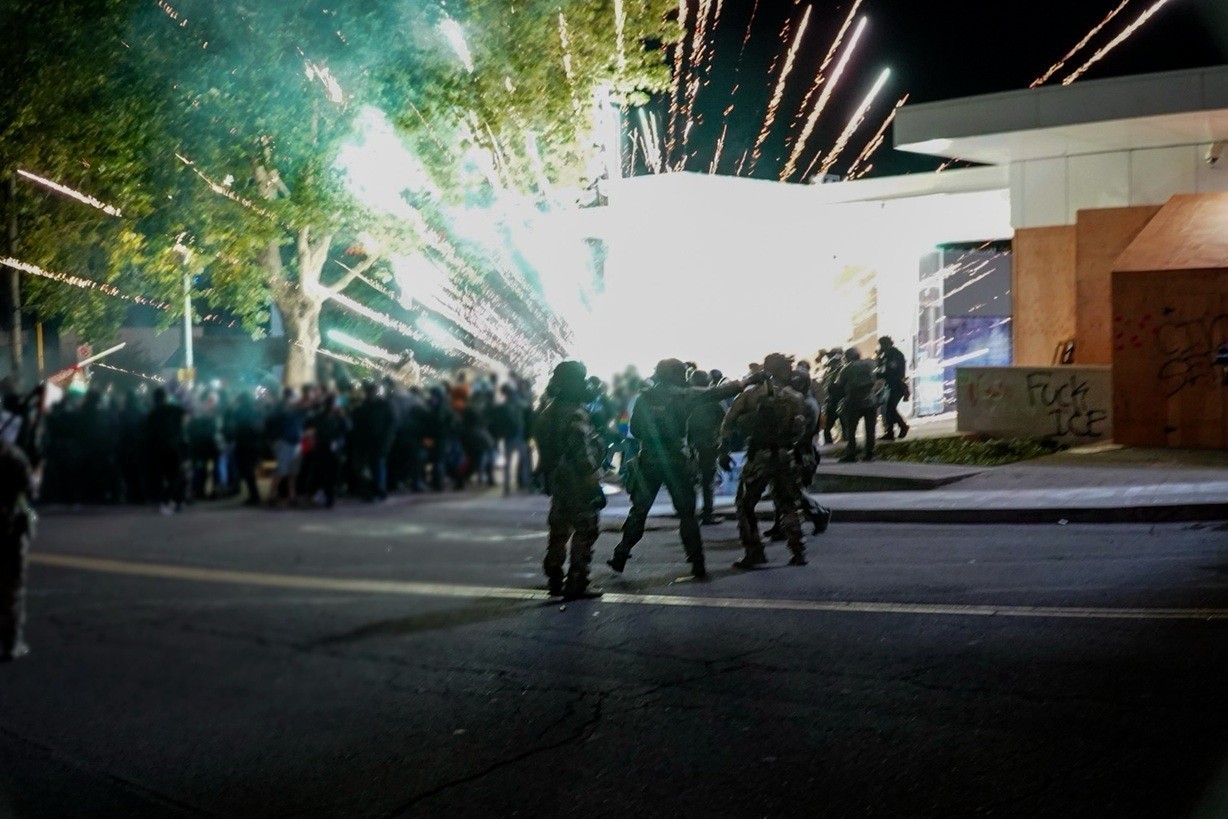
Agents in gas masks burst out of a gated driveway amid curtains of green smoke and other crowd-control munitions. Protesters tell of agents raining pepper-ball rounds down on them from the rooftop of the facility. The demonstrators have been broadly nonviolent — although some agitators have been arrested and brought up on both minor and serious charges.
The habitual deployment of chemical irritants by federal agents has created fear in the neighborhood. Locals have posted biohazard warning signs: “This area has been sprayed with TEAR GAS & TOXIC CHEMICALS.”
As a new academic year approaches, a nearby public school has been forced to abandon its longtime campus, citing threats to student health. “We didn’t know if there are new gases being used. We didn’t even know how to identify them,” says the school’s interim executive director, Laura Cartwright, who committed to an “emergency move” amid cratering enrollment. “If we would have stayed, we might have lost our school because of people’s concerns around safety.”
The makeup and potential health impacts of the chemical munitions used by ICE in the neighborhood has not been disclosed. ICE did not respond on the record for this story, including to questions about its crowd-control arsenal. Anti-ICE activists have begun cataloging canisters collected from the streets outside the facility, posting pictures of munitions labeled “CS,” or tear gas; “Green Smoke”; and “Orange Smoke.” (A demonstrator on the scene also showed this reporter a spent canister of Green Smoke.)
In July, Portland’s city government disclosed it has received reports of “chemical munitions” being used against protestors, including “pepper balls, pepper spray, and… smoke grenades.” It described steps it has taken to prevent ICE’s chemical pollution from entering local waterways. (The city’s own police have been so trigger-happy firing chemical munitions against protesters that the bureau got written up by war crimes investigators.)
Repression against anti-ICE protesters has also been escalating, with the FBI making targeted arrests, the Department of Homeland Security (DHS) attacking anarchist websites for supposedly “doxxing” ICE agents, and “Border Czar” Tom Homan, threatening to send even more federal law enforcement agents into Portland, in retaliation for ongoing solidarity demonstrations.
Wanting to know more about the context of this unfolding scene in Portland, we sat down with grassroots journalist, Alissa Azar, to find out what is really happening amidst the clouds of tear-gas and the ongoing fury against escalating attacks by ICE.
IGD: Broadly speaking, what’s been happening in Portland, OR since protests heated up in Los Angeles, CA in early June? Seems there has been an uptick in demonstrations outside of the ICE facility there?
Alissa Azar: Definitely. Since June 8th, people in Portland have been holding it down outside the ICE field office with consistent, daily demonstrations. It started small, folks setting up tents and establishing a presence, but quickly picked up momentum. For the first few weeks, it looked like an occupation. People were occupying space near the facility despite constant harassment from the Portland Police Bureau (PPB), who kept posting bogus “illegal campsite” notices and threatening sweeps. Sometimes they followed through, stealing and destroying people’s supplies. Other times, folks moved preemptively. But the protest didn’t stop. People stayed resilient and kept showing up.
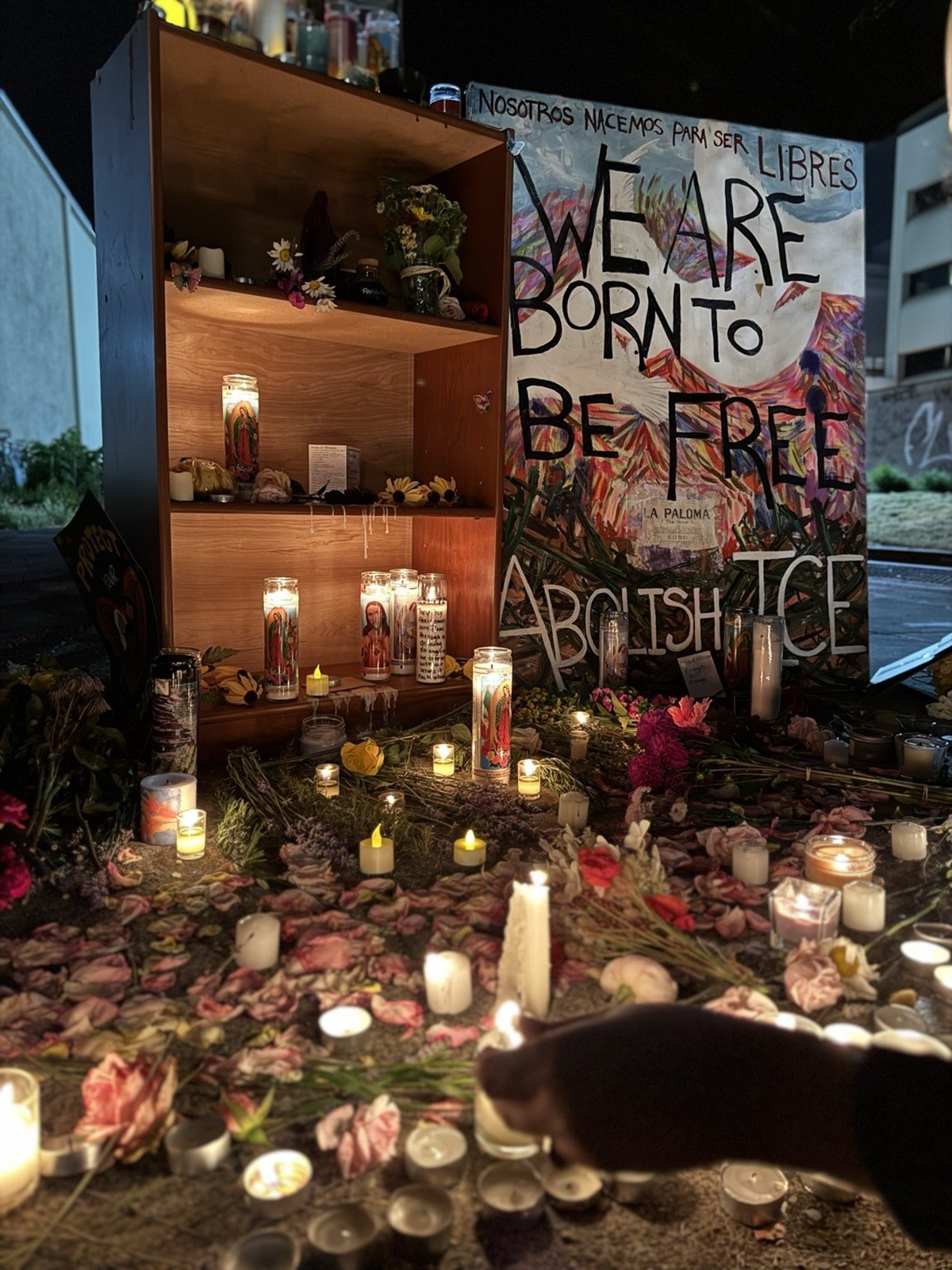
Photo via Alissa Azar
Over time, the energy shifted from a stationary encampment to a persistent, mobile demonstration. Every morning, afternoon, and night, people have been out there in protest, nonstop.
What’s been especially powerful is the depth of community support and the diversity of tactics and events. There’ve been Indigenous-led prayer and dance ceremonies, art builds, nighttime bloc’d-up demos, group bike rides to the facility, bloc parties, dance parties, liberal rallies, cookouts… You name it. It’s been going on every. Single. Day. Mutual aid has been constant, with folks bringing food, medical supplies, water, and whatever else people need. I remember being overwhelmed by the sheer number of cars honking in support on multiple occasions. At some point, you get used to the noise, but it’s a beautiful thing to grow numb to.
IGD: This place was also the scene of the Abolish ICE occupation protests in 2018, how has this history influenced, if at all, the recent demonstrations?
Alissa Azar: I think it would be naive of me to assume there aren’t at least some of the same people involved now who were part of the 2018 occupation. Portland has a long memory, and one of the things that makes this city magical is how often you see people from different waves of resistance, different generations of struggle, showing up alongside each other. There are a lot of lessons and information that get passed on through shared experiences, and that’s really special.
Still, this moment feels different. Perhaps not any more strategic, but there’s certainly a hunger for it. People are tired of symbolic gestures. They want to be intentional, to organize and act in ways that feel grounded, effective, and harder to co-opt. There’s a tension between that desire and the reality of intense surveillance, burnout, and the sheer speed at which things are unfolding. But the desire is real, the energy is real, and that means something.
— Rolling Stone (@rollingstone.com.web.brid.gy) 2025-08-22T13:00:00.000Z
That shift feels especially important given how much the landscape has changed. Now, that same violent machinery responsible for ICE raids and deportations has expanded its targets. Migrant communities are still being brutalized, detained, disappeared, and deported, but we’re also seeing increased surveillance and repression aimed at those who show up to resist that violence. Protesters are being tracked with AI, filmed by drones, and snatched by federal agents in unmarked vans. They’re being criminalized just for showing up. So while the roots of this movement go back to 2018 and long before, the stakes feel exponentially higher, and the state’s repression more violent, strategic, and widespread.
IGD: How have police and federal law enforcement responded to the protests?
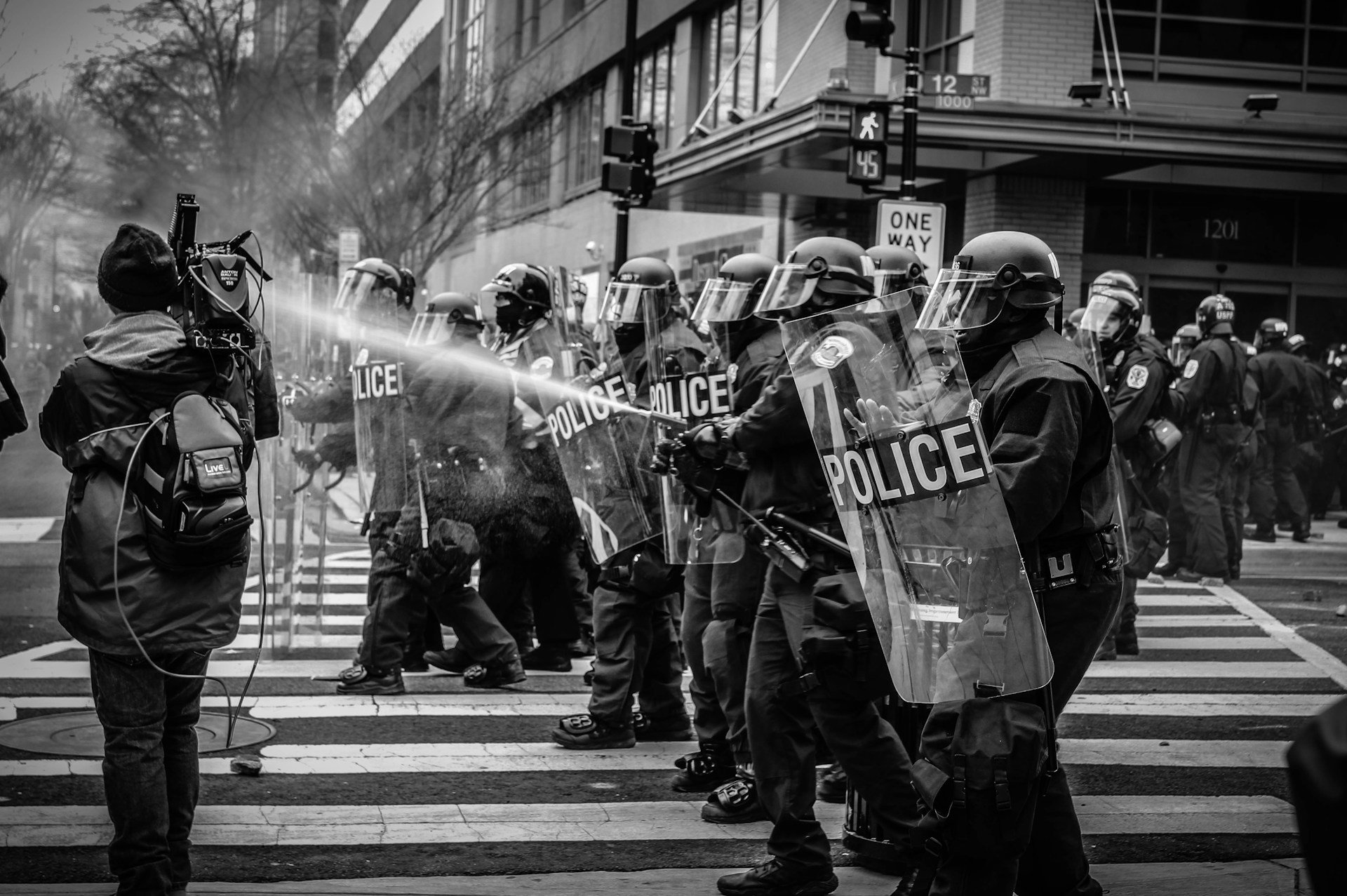
Alissa Azar: In the first month, especially the first two weeks, the police response was heavy and brutal. The Portland Police Bureau (PPB) showed up every night with large bike squads rolling through, riot vans, and squad cars stationed all around the ICE building. The scene was almost always the same: protesters gathered on the sidewalks or driveway, and federal agents would clear the way for their vehicles with violent force. They fired thousands of pepper balls at close range, launched tear gas canisters aimed at people’s heads, charged at random individuals, and made violent arrests to clear their driveway. Targeted arrests, like for alleged graffiti, were mostly done by PPB early on after being given descriptors from federal agents.
Surveillance technology is helping criminalize resistance
— Alissa Azar (@alissaazar.bsky.social) 2025-07-31T17:50:38.865Z
During this, Chief Day and PPB attempted to manage optics by claiming they don’t engage in immigration enforcement in each press release about an arrest they made at ICE, trying to distance themselves from federal agents. But behind the scenes, they continued working with the feds to identify and build cases against demonstrators. While PPB’s presence has been less overt lately at ICE in the way they were at first, they’re still around and surveilling activists.
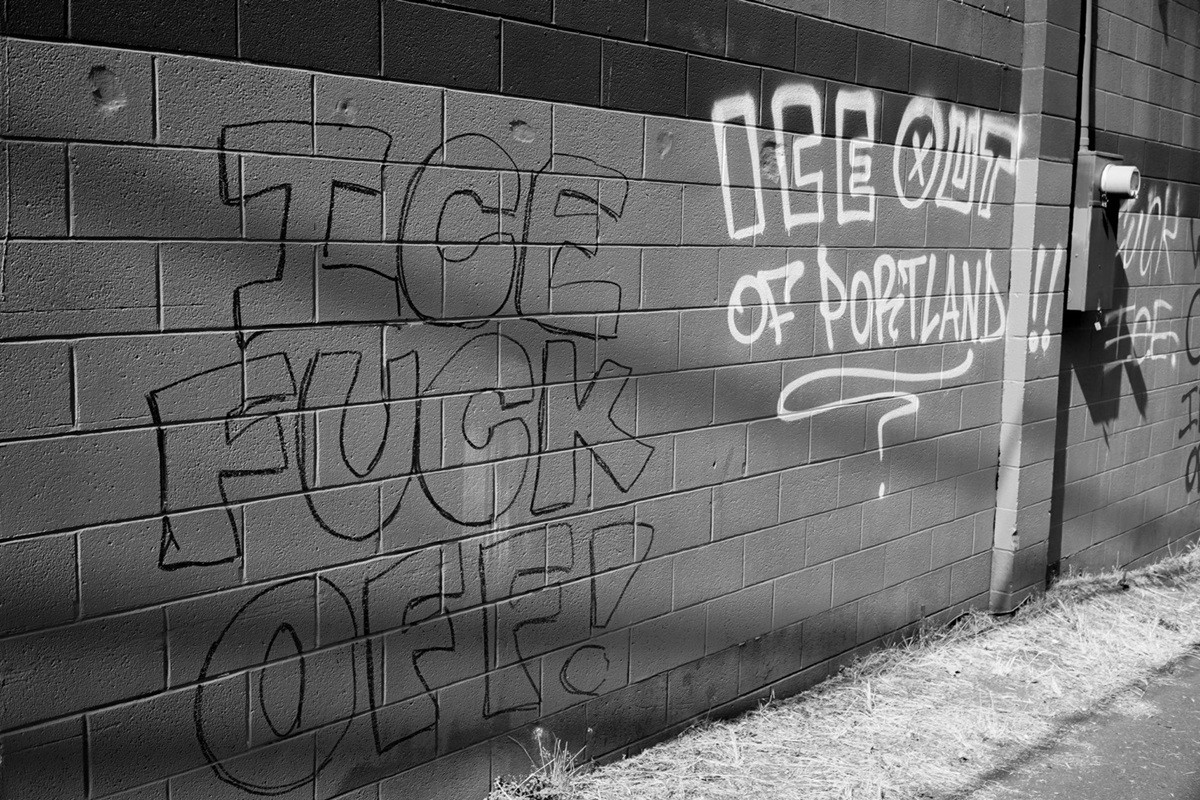
Photo via Alissa Azar
Meanwhile, federal law enforcement presence and violence have only escalated. BORTAC and other federal agents from across the country flooded in…some wearing Texas patches, one sporting a “Portlandistan” patch. The violence they’ve inflicted has sent at least 11 people to the hospital with serious injuries. They’ve fired tear gas and munitions in massive quantities, sometimes shooting munitions from rooftops. People have been arrested on fabricated charges, detained, ID’d, and released. Neighbors by the facility are buying gas masks for their toddlers because of all the chemical weapons seeping into their homes. It’s bad.
The repression has also escalated beyond the streets. One person arrested by PPB had the FBI show up at their home weeks later and arrest them on federal charges. Another who had never been arrested had over 20 federal agents show up to their home and point ARs at them and their housemate before taking them into custody. Several people now face serious federal charges, and it’s clear that law enforcement’s surveillance goes far beyond in the moment at the ICE building protests themselves.
IGD: Tom Homan and others have made a lot of noise about the protests as “storming” the ICE facility, and have promised to return to Portland with greater intensity, what do you make of these threats and the narrative that protesters are a violent threat?
Alissa Azar: The whole “protesters stormed the ICE facility” narrative is pure bullshit. Sure, a glass door got broken, and people were standing in the driveway and on the sidewalk, like they always do when protesting there. That’s literally it. But that lie spread fast, because fabrications like this are a classic move by law enforcement, fascist regimes, and the media to justify repression. It’s what fascists do: invent threats to manufacture consent for violence and authoritarian crackdowns.
ICE tear gas the whole neighborhood for no reason, then come out and pepper spray and shove protesters for flipping them off. @ICE out of Portland
— John Thelefty (@johnnthelefty.bsky.social) 2025-08-17T19:49:03.038Z
Their strategy relies heavily on fear, scaring the public into accepting even more repression. But it’s crucial to remember the historical context: these lies always come before escalations in state violence. The narrative they push isn’t just about controlling the present; it’s about paving the way for more brutality to come, making the next wave of repression seem necessary or even inevitable as they attempt to normalize the police state.
IGD: What is the state of the demonstrations currently and where do you see things going in the future, especially with Portland’s history of mobilizing against Trump?
Alissa Azar: As I mentioned earlier, things have definitely shifted and continue to evolve. Right now, there are still ongoing daily demonstrations, with certain days or nights bringing out bigger crowds, sometimes specific communities responding to flyer campaigns or calls to action. But honestly, I think a lot of people are feeling a bit tapped out in regard to the demonstrations currently happening. I deeply respect those who can’t stand the idea of inaction, but there’s also something to be said about strategy and remembering this is a long game.
So many folks have faced extreme violence and been charged for simply standing on a sidewalk across from ICE. That kind of repression, combined with insane levels of surveillance, makes showing up feel unsafe and unsustainable for many. At the same time, a lot of people just want to do something; they’re frustrated, angry, and looking for ways to resist. That’s totally understandable, too. But I also think people want to be strategic. They’re asking: What actually makes an impact right now? What’s worth the risk? That kind of reflection isn’t a sign of people backing down; it’s a sign of movements maturing and adapting.
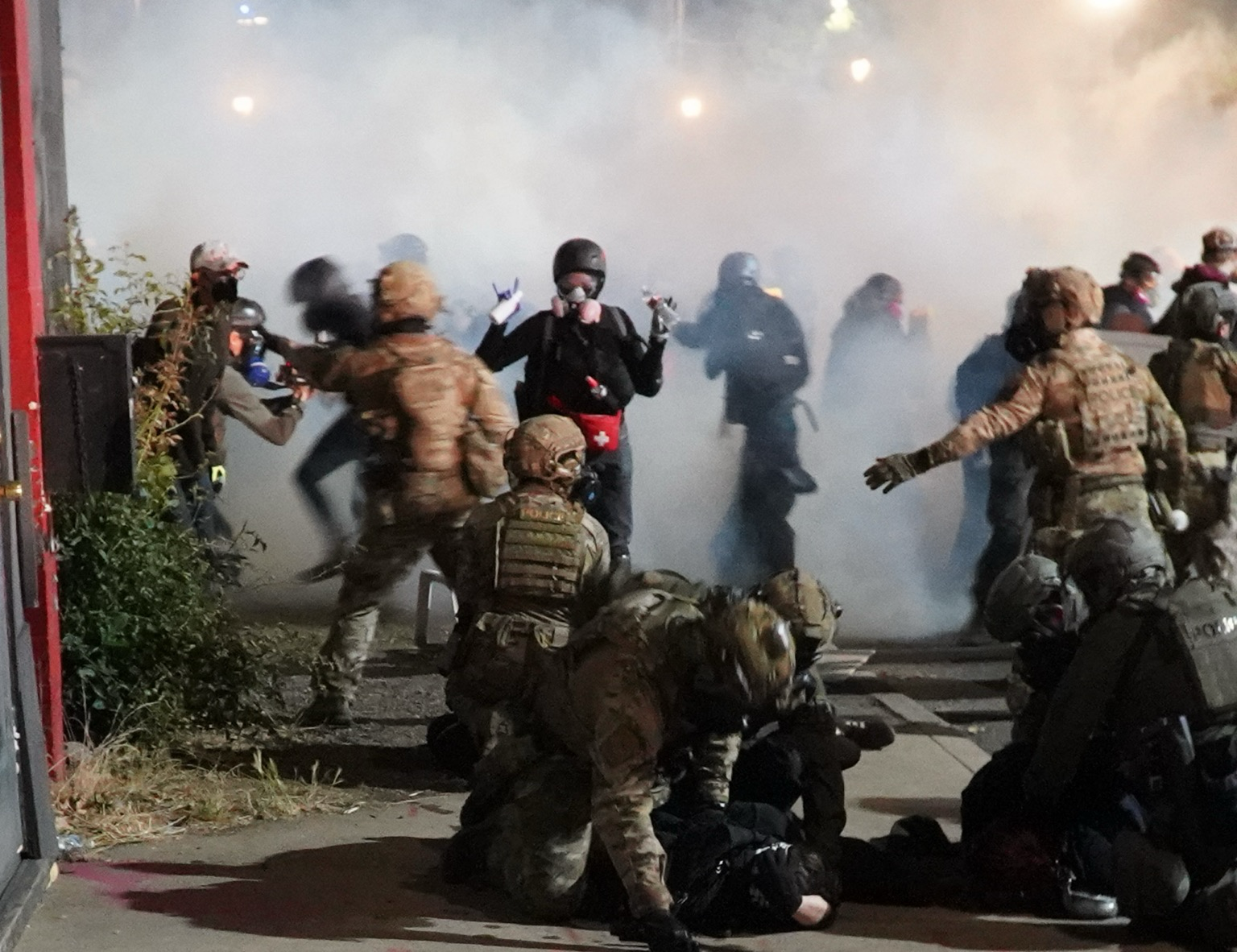
Photo via Alissa Azar
Where things go from here is hard to predict because everything is changing so fast, and tensions are escalating quickly. What I do know is that resistance has to keep adapting… our tactics, our strategies, our ways of organizing all have to evolve as the situation changes. And I think that’s exactly what many people are doing; finding new ways to resist and defend our communities, getting ready for what’s to come, and strengthening mutual aid networks.
IGD: Where can people follow your work?
Alissa Azar: I finally launched my website, www.wewillfree.us, where I will be posting more articles and photos, never behind a paywall. People can also follow along on my socials:
Mastodon: kolektiva.social/@alissaazar
Instagram: www.instagram.com/alissa.azar
Bluesky: bsky.app/profile/alissaazar.bsky.social
cover photo via Alissa Azar