 Events
 Podcast
 Columns
 Library
 Contact




Jan 31, 25
Filed under: Action, Community Organizing, Northwest, Solidarity

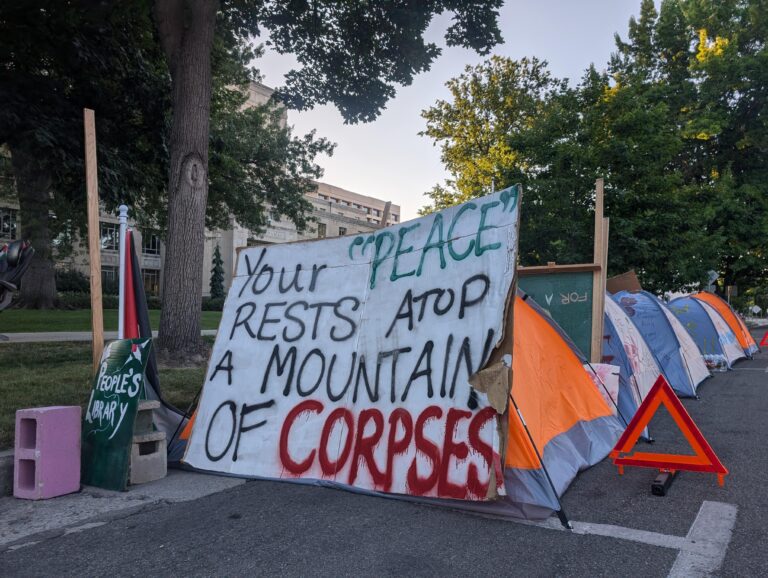
Report and critical analysis of the encampment in solidarity with Palestine in Boise, ID. Warning, this includes discussion on sexual assault.
There were a lot of nearly perfect days at the People’s Liberated University (PLU) during its one-hundred and sixty-four day run. When the weather was perfect, the space felt safe and welcoming; it felt like we could take on the world together.
On any morning of one of these nearly perfect days, the sun would come up over the Ada County Courthouse and wash down the encampment, eventually landing on an overnight crew. The crew might be huddled closely in a circle, sitting on discarded and scavenged office chairs. They would be whispering, sometimes laughing uproariously, about news, jokes and stories. They might not have been a crew previously but passing a night together in this way made them into a crew quickly.
Over time, a morning crew would filter in and the overnight crew would filter out; more sharing of news as they passed. Sometime during this transition, food crew would bring breakfast for anyone with an appetite. Another transition at this time was the overnight protracted encampment blossoming into a street display. Signs and tents, stowed for the night, would emerge into position on the lawn facing car and foot traffic.
After the day initialized, nothing changed but the time and the temperature. It got warmer as the day wore on, sometimes hot, even. On the hot days, laying low in the shade was a must. No matter the temperature or weather, though, sitting around was the primary activity. People came and went through the space as needed but Holding Space in Office Chairs was the primary function until another activity came along. Usually, this meant nothing happening all day. If something did happen, it happened in the afternoon or evening after the heat broke and people were getting out of school or class.
Sometimes, the afternoon of a nearly perfect day would be punctuated by an emotional support group that would discuss the ongoing trauma of their state enabling genocide. Other times, the community would put on a show, talk, or teach-in to raise awareness, educate, or fund raise. Those who fund raised did it with the idea and intent they were raising money for people struggling in Gaza. One of the most perfect days included a community organized talent show featuring musical and drag performances. Even this nearly perfect day was tainted, though; more on that later.
As the sun set on these nearly perfect days, the tents and signs would be taken down and stowed for the evening. Food crew would come back through, pick up leftovers from breakfast, and drop off dinner. Office chairs that had been scattered around the encampment through use were huddled, once again, into circles as night crew filtered in and day crew filtered out. It was at these points in the late evening and early night, even on the nearly perfect days, that the state police incursions and outside hostilities generally materialized.
On the most perfect of the nearly perfect nights after the nearly perfect days, the amount of supporters in the space was enough to give threats, both from the streets and from the state, second thoughts about bothering or harassing the PLU. On most nights, though, security guards, city or state police, scooter kids, and randomly timed sprinklers were frequent disruptions and distractions to the space. When the potential for threats had passed, night crew would settle into their circle and begin their shift again, sharing news, jokes, and stories, sometimes laughing uproariously.
Now that we have covered the near perfection of idyllic days passing tranquilly like a lazy river, we have to discuss the less-pleasant and dangerous current underneath. Unfortunately, and heartbreakingly, yet not surprisingly: power corrupts. Patterns of abuse and manipulation emerged, nothing about that is new or interesting but when it happens in front of you by your allies and friends, not as a warning in a report back or zine, it is easy to be caught off guard and unprepared to respond. These reflections, though difficult, must be made as an accounting and apology to the victims we have failed and to serve as an attempt to prevent further and future harm.
In order to understand how harm was enabled in a horizontal, autonomously organized, setting, one must first understand that not everyone was keeping a horizontal, autonomously organized setting. The concepts, ideals, and organizing principles established at the outset were almost immediately abandoned. Replacing stated ideals and principles was top-down leadership and social manipulation. In-groups against out-groups were formed and reified. Through the use of “us against them” language, and a constant creation of a “them,” there formed an “us” that was fiercely loyal to the few in leadership calling out targets. These struggles against targets replaced all transformative justice and mediation attempts. Instead, someone was an enemy until leadership deemed that they were not. They were constantly and relentlessly targeted and attacked. Their validity, even their privacy, was publicly violated; their private messages were shown to the entire in-group and used to mock them. If they were deemed ally again, all memory of them as enemy was immediately abandoned, all harm done to them in service of the PLU was immediately forgiven and forgotten. If you were in the right, things were alright. This harmful practice was defended and denied, constantly, by referencing the abandoned principles. “I thought we were autonomous!” and “I thought there were no leaders!” were thrown out snidely, derisively, defensively by leaders when alarmed members of the space brought up the patterns of abuse. Denial of harm, denial of responsibility, denial of reality became core principles of the space.
It is time to examine how the (seemingly opposite) concepts of near perfect and enabling of harm can be present at the same event now that we have established frameworks for understanding each in the space. In mid-July, around 70 days into the encampment, a beautiful event —a talent show— was held at the PLU. It wasn’t particularly well promoted or well attended but it was put on with so much heart, by so many different contributors, that it was easily one of the most incredible evenings in the space. The performers were bold and some wore beautiful, homemade, costumes. The stage was the Old Ada County Courthouse steps. The audio was a microphone tied to a wagon handle, extended upwards to the right height. Music was performed, poetry was read, flowing was danced with LED lights (twin light up fans synced to music). It all built up to spectacular and overwhelmingly moving pair of drag performances at the end of the night. There were so many different groups and crews that showed out that, for many people on that summer night, this was the nearest to perfect that the space ever was.
Within that time and space —the most perfect evening at the PLU— an alleged sexual predator freely moved. The sexual assault allegations were still under wraps at this time but camp leadership was aware of them and was, supposedly, handling them. The two alleged victims were present that evening as well, hoping to be in community and away from their victimizer; that was not the case. The PLU leadership welcomed the alleged perpetrator and not the alleged victims on this night. The victims hid in a van at the PLU, isolated away from community, away from the beautiful night, to put distance between them and the person who had harmed them. Later, someone from the PLU leadership talked to the victims and, according to her, the victims denied the sexual assaults and that was the end of it. It was not the end of it, though. The victims disappeared from the PLU, disappeared from the area. They stopped coming around and then a graphic and heartbreaking post depicting the assaults appeared on social media in what seemed like a last ditch effort to bring the harm to light. It also included a specific call out of the PLU leadership that had failed them.
What happened after that can only be described as a shameful cover up. Instead of addressing the allegations and the failing of the victims, the same people that had failed the victims publicly washed their hands of responsibility. Instead of addressing their harm, they went on the offensive against anyone who expressed agreement with the victims’ allegations of failure. “Why is it our responsibility?” was thrown up defensively, just another in the line of the usual denials, accusing anyone seeking to address this harm of trying to hurt the PLU. This is not victim-led justice, it is defense led victimhood. The defense falls apart with the knowledge that leadership responsibility began earlier when they were briefed on the situation and agreed to address it with the victims, leading to the call out after they failed to address it. The victims needed them and reached out to them. They deserved and expected support and received none.
Protecting the space seems to have been more important than protecting the victims. Once this pattern normalized, this led to further victims from other predators in the space. The victims in those cases have not chosen to make their experiences public and so they have not been covered here. When those victims ask for justice, they should be listened to, though. They should not have to make lonely posts on social media begging for justice in order to be heard. Victims in our community should never stand alone.
Overall, most participants of the PLU did not know about this harm before the call out post. After the call out post, most accepted leadership’s self absolvement as another in a long line of harm that “wasn’t as bad as it sounded” or things that they were not responsible for. Most people, genuinely, can claim, “I didn’t know.” There are those who did know, those who helped to cover up this and myriad other harms, including theft of funds meant for Palestine alongside what appears to be gross misappropriation. There was outright theft of funds, admitted to by leadership, that they felt did not need addressing because other donations were used to fill the hole created by the theft. Additionally, when questioned about the theft, leadership claimed that only half of funds raised in the encampment went to Palestine or any causes outside of the PLU. Fundraising asks, including physical signage, never mentioned that any of the money was being used by people within the encampment, for what or why. There was not informed consent that donations for Palestine were being wasted on frivolous things at the personal discretion of leadership that denied even being leadership. The asks were, very specifically, “SAVE LIVES IN GAZA, DONATE TO US” without any transparency. Further, people dug deep into their own pockets to support the PLU organically, not knowing funds meant for Palestine were being gathered and used for it.
These three issues – the toxic in-group culture, not standing with victims, and misuse of funds – represent the ugly, irredeemable, aspects of the space. The people —the leaders in benefit but not responsibility— are, hopefully, redeemable, though. These failures should be examined, harm should be repaired (where possible), and we should all learn and grow from these things as we continue forward in this community and we, collectively, push for liberation of Palestine and all peoples. It is not our hope to villainize or demonize anyone with this writing. Instead, this is an effort to address the things that prevented the space from being what it could have been and what prevents us from being what we could be. We should have done better, we did not. Through honest self reflection and genuine interest in doing so: we can grow from this. We can do better going forward, but only with honesty and care.
We stand with Palestine, we stand with victims, we stand with the community.