 Events
 Podcast
 Columns
 Library
 Contact




Jul 31, 25
Filed under: Announcement, Mexico, Repression, Solidarity, The State

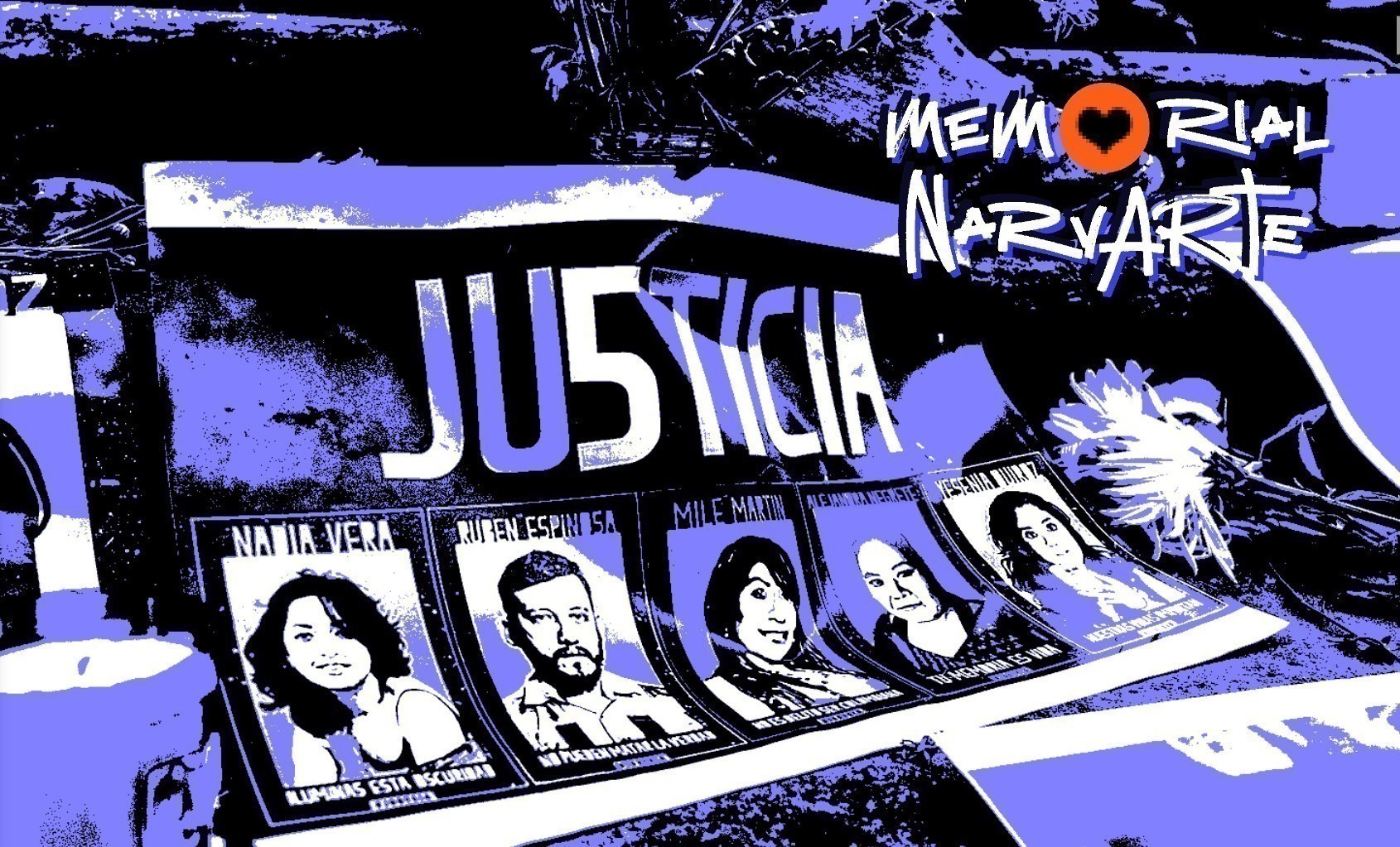
On July 31, 2015, Alejandra Negrete, Mile Martín, Nadia Vera, Rubén Espinosa and Yesenia Quiroz were murdered in an apartment in the Narvarte neighborhood of Mexico City. In the ten years since, their family members, friends, and comrades have been demanding justice and struggling to keep their memories alive. While three people have been detained for the killings, evidence ignored by the Mexico City prosecutor’s office implicates former officials of that office in the killings. It has also refused to investigate the role of the administration of Javier Duarte, former governor of Veracruz, from where Nadia, a radical activist, and Rubén, a journalist, fled fearing for their safety after receiving threats. To mark ten years, those accompanying the families in their search for truth and justice have created a digital common archive: Memorial Narvarte. Below is a text announcing the archive along with a piece by Mirtha Luz Pérez Robledo, the mother of Nadia Vera. Both were translated by Scott Campbell.
Memorial Narvarte: An Archive for the Future
Ten years after Alejandra Negrete, Mile Martín, Nadia Vera, Rubén Espinosa and Yesenia Quiroz were taken from us, we continue putting faith in collective memory.
After the multi-femicide and homicide that occurred on July 31, 2015, in an apartment at 1909 Luz Saviñón Street in the Narvarte neighborhood of Mexico City, authorities tried to create a “historical truth,” to shelve the case without considering that Nadia and Rubén fled from threats in Veracruz, and without following the different lines of investigation linked to Nadia’s activism and Rubén’s journalism. What followed would be a demand for justice in the face of criminalization, revictimization, xenophobia, and discrimination against the 5; as well as a collective demonstration of resistance and living memory.
Over the course of this decade, together with their families and allied organizations, we made space amid State neglect and abandonment. We want to continue building a dissident common sense to the hegemonic narratives regarding the recent history of our country and the acts that mark us. That is why we are building a common archive, a space of digital memory to remember them: memorialnarvarte.org.
This collective archive compiles statements, photographs, videos, texts, audios, artistic pieces, along with other elements that mark a decade of struggle, memory, and resistance for the 5, as well as collective expressions in homage to the victims. It is a self-managed initiative born of the accompaniment group Memorial Narvarte, which also organizes the Festival Arte Para No Olvidarte (Art to Not Forget You Festival).
What do we honor when we create a space of memory? How do we care for those who were taken from us? What communities are created out of grief? How do we confront the paralyzing horror? How do we nurture and sustain a memorial, in person or virtually, over time? These are questions that accompany us and that we have woven collectively with others.
Creating a memorial is not just a symbolic act: it is a form of inhabiting the present with dignity. It is to reclaim our history and our future. It is to say that in this country, where justice is feigned, there are those who do not surrender. There are those who, with each act of memory, continue making visible what they wanted to erase.
We thank all those people who, with their words, presence, images, and accompaniment, form part of this archive. If you want to collaborate, you can email your contributions to festival.narvarte@gmail.com and find us on social networks as @memorial.narvarte.
We will continue to name Nadia, Rubén, Mile, Yesenia and Alejandra. We will continue to demand justice. Because there are dead who will never be silenced. Because memory is also an act of the future. Because as Mirtha, Nadia’s mother, says, the word heals and repairs, it is the only thing they cannot take from us, the power of our words.
“What I cannot say: A decade of impunity”
by Mirtha Luz Pérez Robledo, mother of Nadia Vera
The worst form of injustice is pretended justice. – Plato
For 10 years we have had a feeling of impunity, complicity, and cover-up because the ineptitude of the Mexico City prosecutor’s office has nothing to do, as we originally thought at the beginning, with distraction and the lack of willingness, but with a manner of operating that is systematic: regardless of what political party they belong to, elected or not, they behave like dominoes, they are moved by inertia, and they do not go or see beyond their interests.
The echo of my scream arrives muffled, distorted, and dies in the penumbra where bureaucrats write the rules of the game that we will never be able to change.
A decade after the Narvarte murders, which occurred on July 31, 2015, where the life of my daughter, Nadia Dominique Vera Pérez, the journalist Rubén Espinosa, and three other people were taken, we still do not know where the weapon is, nor what the motive was, and what we know from independent investigations has taken years for the prosecutor to accept: that there were more than three murderers.
We cannot name names as they hold us responsible and lower us to the level of a criminal, while defending the rights of criminals and even more so if they are employees of that institution.
Here the word returns, to be spoken alongside Bachmann, to say dark things.
Wanting to say does not make us say, wanting to say does not allow us to say what we want to say.
That is why I write, to be able to get out of this experience of grief; the word, these words, give me freedom and I am not strong like the world asks of me but, thus, I dignify my fragility.
I try to speak because to remain silent before an institution that lies would be an anti-life position.
Resorting to language to try to name the unnamable, to make myself heard, to unravel the lie, to condemn inaction.
To speak to demand the truth.
“Because the true opens cracks in the wall, the true separates the headstone from your tomb”
The demand for truth is perhaps the only effective means to undermine that wall of silence that the real powers have tried to impose on us.
So here, I say what I cannot say and not only because language is arbitrary. I cannot speak because they won’t let me tell the truth, because there is not one truth, there are many truths that hide the true truth.
I say that I cannot speak because the language of the justice system excludes me and makes me a vassal of imposed language, which if I dare to break could set free not one, but three murderers.
I say that I cannot speak because the lawyers’ strategy does not allow me to speak: subtleties in the interest of achieving minimum justice.
I say that I cannot speak because the operating system of the justice system will not allow me to speak, that which coopts the operators of the same system who carry out poor investigations and cover up for criminals. This system puts the victims in a cell that, in its infinity, reflects the constant state of uneasiness, the incessant search for meaning that is not found, just as the imparting of justice is not found and the truth is not found. The system has a deaf muttering that interweaves unfulfilled promises and failed hopes.
Those who say they impart justice, those who investigate, are those who lie and pretend to do something but do nothing and allow time to pass. They promise meetings and when there are, they arrive late and leave quickly and lose files and confuse the telephone numbers of predators but expose the victims and revictimize them. It is a constant, permanent institutional violence that is backed by another institution, which says that it protects human rights, but they are a conclave, a sect, and a society that covers up and only protects their interests. And if you dare to speak, to say what you know, then they gather the media and give free rein to their lies and the entire media, with honorable exceptions, repeats what they have been given to repeat.
I say that I cannot speak. Whoever has eyes let them see, and whoever has ears let them hear, and whoever wants to understand let them understand.
Mirtha Luz Pérez Robledo
The mother, the woman, the citizen.
They can kill us, but they can never destroy us.
July 2025