 Events
 Podcast
 Columns
 Library
 Contact




May 4, 25
Filed under: Community Organizing, Gentrification, Repression, Southern Mexico


Reflection on state repression and the increasing use of grupos de choque in the southern Mexican state of Oaxaca.
The grupo de choque has become a principal weapon in the arsenal of repression of the government of the so-called Primavera Oaxaqueña, or the Oaxacan Spring. Salomón Jara Cruz, the current governor of Oaxaca and member of the MORENA party, has repeatedly used violent para-state groups to attack and brutalize protestors, street vendors, road blockades, or any other obstacle to his political and economic project in the state. His other tools of repression have included threats, intimidation, criminalization, persecution, and even assassinations; the latter often attributed to “organized crime,” even while the close relations between the governor and organized crime groups have already been well documented.
The grupo de choque has a long history of use in Mexico, particularly in the university context where they are known as porros. With the founding of the National Autonomous University of Mexico (UNAM) in 1910, and its declaration of autonomy in 1929, porro groups began to appear on campuses organized by university and government authorities to repress student movements. With police not allowed on autonomous university campuses, state and university authorities have continually used porro groups to break up student organizing and student resistance. Yet, grupos de choque aren’t only used in universities, but have been mobilized in many different settings becoming an integral part of the state’s power and authority in Mexico.
In Oaxaca, with Salomón Jara Cruz as governor, and his brother Noé Jara Cruz serving as Secretary of Government and Territory of the Municipality of Oaxaca de Juárez, there has been an intensification in the use of grupos de choque. The most recent attack occurred in the center of Oaxaca City on April 7, 2025, just before midnight, when around fifty people arrived to the street market, the Tianguis Cultural Libertad y Resistencia in the Plazuela del Carmen Alto. The grupo de choque physically attacked members of the Tianguis Cultural and destroyed the wooden booths from which the artists sell their work. One artist had his nose broken and ribs bruised as a result of the attack and beating.
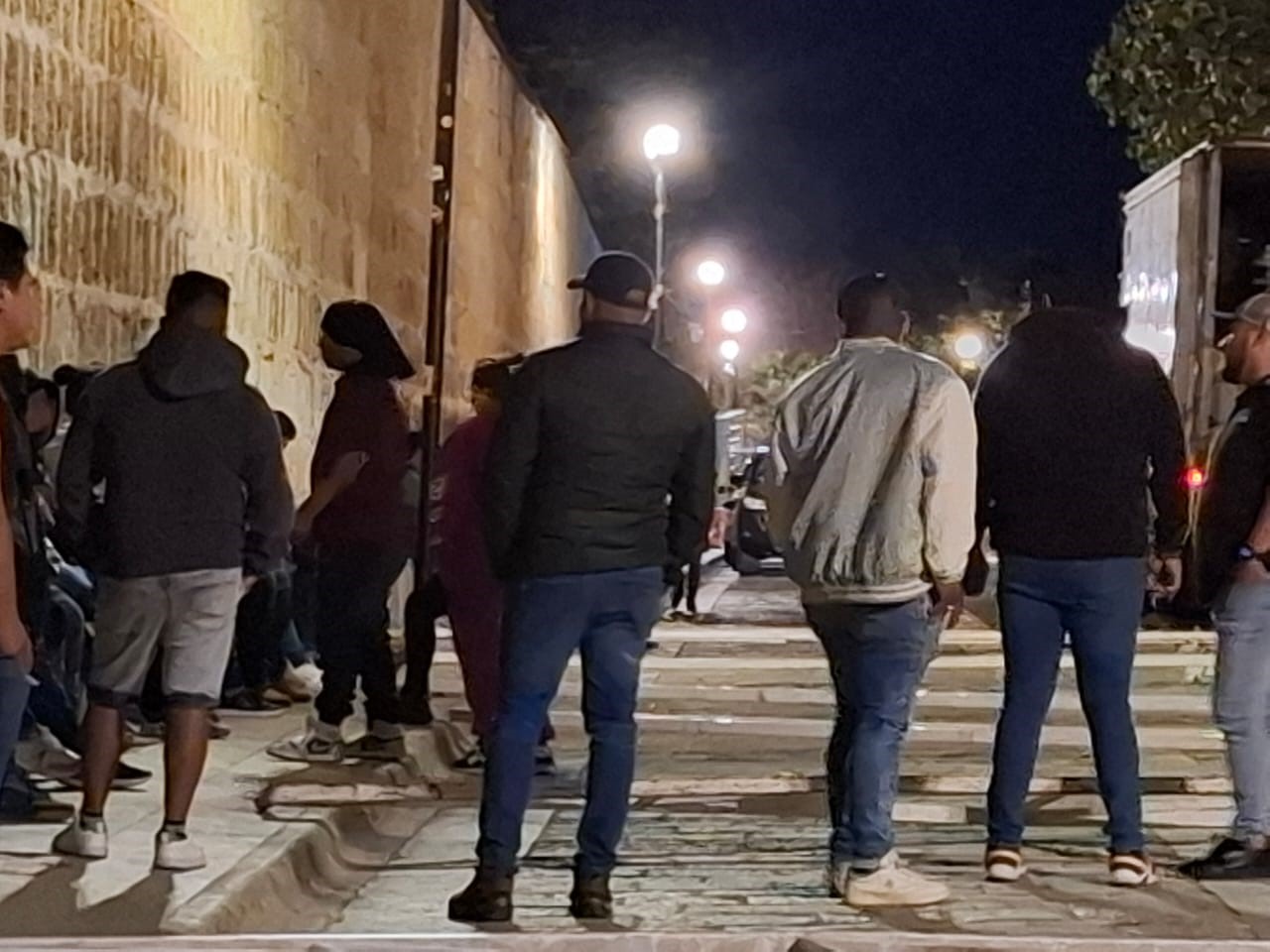
Grupo de choque near the Plazuela del Carmen Alto. Photo: Avispa Midia
The Plazuela del Carmen Alto and the Tianguis Cultural is a collectively organized space of artists and local producers who sell their products and organize cultural and political events, holding down one of the few remaining public spaces in the rapidly gentrifying Oaxaca City. The municipal government, and specifically Noé Jara Cruz, had already been threatening members of the Tianguis, seeking to displace the artists in order to rent the space to government affiliated merchants who have the political and economic capital to pay higher quotas. Members of the Tianguis Cultural quickly named Noé Jara Cruz as well as the municipal president of Oaxaca de Juárez, Raymundo Chagoya, as those responsible for ordering the grupo de choque attack. They also named the union CATEM Joven as the ones physically responsible.
Earlier this year, on January 14, 2025, another grupo de choque attacked local community members protesting the imposition of a trash transfer center on almost eight acres of land on the border between Santa Cruz Xoxocotlán and San Antonio de la Cal—two rapidly urbanizing municipalities on the periphery of the capital city of Oaxaca. The trash transfer center is being imposed without a consultation or consent from the surrounding neighborhoods, and is an ill-conceived quick fix to a trash crisis affecting the central valleys of Oaxaca.
On January 14, neighbors had taken over and blockaded one of the principal highways traversing Oaxaca City, Avenida Simbolos Patrios, demanding the cancellation of the project. The state responded with a grupo de choque, attacking the blockade and physically beating and threatening community members. Neighbors and members of the protest recognized again those involved in the grupo de choque attack were members of the union CATEM Joven.
And last year on June 5, 2024, a grupo de choque armed with sticks, rocks, machetes, and guns attacked a teacher’s protest at the entrance to the international airport of Oaxaca in the community of San Juan Bautista La Raya. The airport blockade followed weeks of protests carried out by the Oaxacan Section 22 of the National Coordinator of Educational Workers (CNTE) which had kicked off on May 15, “Day of the Teacher.” As the protests escalated, and the blockades expanded, the teachers took over the airport causing the cancellation of flights and the loss of significant amounts of money.
On June 5, the grupo de choque attacked the teachers’ protest attempting to evict the blockade and allow for normal traffic to be restored to and from the international airport. Cars and motorcycles were set on fire. Multiple teachers were injured, including one by gunfire. The media and state quickly developed the narrative that the attack was carried out by neighbors upset about the blockade. Yet, community members quickly clarified that they were not involved in the attack, and it was members of a taxi drivers union who had carried out the attack. Once again members of CATEM Joven.
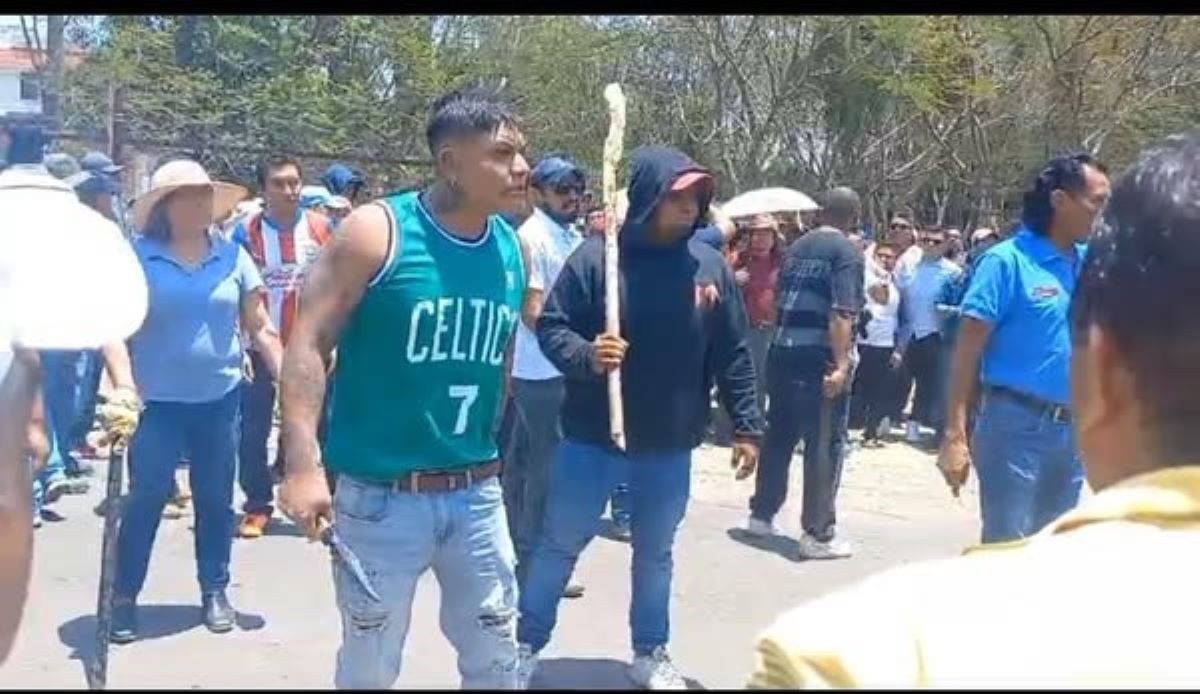
Grupo de choque threatening the teacher’s blockade.
These different attacks aren’t isolated from one another, and they are directly related to Salomón Jara’s political and economic project in the state. Firstly, Salomón Jara Cruz has positioned tourism as one of the principal visions of his government, and his actions have responded to that vision. The breaking up of the blockade on the airport, the excessive amounts of trash produced by the tourism industry, and the attempted eviction of a street market in the tourist center of Oaxaca City, are all directly related to a city and state overwhelmed by tourism. The government of course, responding to the interests of capital, has sought to forcefully impose the expansion of the tourism industry, at the expense of local people and local ecology.
Secondly, an important characteristic to these grupos de choque is that they are commonly made up of right-wing, government affiliated union members—taxi and moto taxi drivers; water, gravel, and cement truck drivers. These unions work hand in hand with the state—they are the state—carrying out violent attacks in exchange for government contracts, the control of certain routes, etc. These same para-state political and union groups intervene in state and municipal elections, supporting certain political parties and candidates, ensuring that they win to ensure their contacts and benefits from the state. These unions and the state scratch each other’s backs, mutually ensuring the exploitation and plunder of the territory, and the misery of the population.
Lastly, these grupos de choque aren’t unique in their activities, but are part of a larger arsenal of repression, violence, intimidation, and terror unleashed against movements and communities in resistance, as well as the population as a whole. To these attacks we can add other recent forms of repression in the state particularly in the Isthmus of Tehuantepec: the killing of three members of the Union of Indigenous Communities of the Northern Zone of the Isthmus (UCIZONI)—Wilfrido Atanacio, Victoriano Quirino and Abraham Chirino—on February 13, 2025 in the Isthmus of Tehuantepec, and the killing of land defender of Barra de la Cruz, Cristo Castro Perrera, who was assassinated on February 28, 2025.
Furthermore, we should mention the criminalization of Indigenous Binnizá community members of Puente Madera for defending their communal lands against the construction of an industrial park; the criminalization of Indigenous Chontales of El Coyul for defending their communal lands against privatization on the Oaxacan coast; the criminalization of 23 Indigenous Ayuuk and Binnizá from Mogoñe Viejo and Rincón Viejo, Oaxaca for defending their territories against the multiple projects related to the Interoceanic Corridor megaproject.
Amidst the threats and intimidation, criminalization and persecution, beatings and assassinations, the communities, neighborhoods, barrios, and pueblos continue resisting. In the face of state and para-state repression and violence, the only pathway forward, the only pathway for survival, is organization and resistance.
Cover Photo: Tianguis Cultural Libertad y Resistencia