 Events
 Podcast
 Columns
 Library
 Contact




Mar 23, 25
Filed under: Analysis, Capitalism, The State, US


A look at the evolving authoritarian makeup of the second Trump presidency and the threat that it poses. Originally published at The Now Times.
We are now 9 weeks into the second Trump presidency. In that time, nothing has occurred that suggests we are not on the path of the Worst Case Scenario — an overtly fascist movement making moves toward an overtly fascist government. The administration has articulated its right to a Monarchical form of power in line with the strategy of the Butterfly Revolution articulated by Curtis Yarvin. There are, of course, other ideological forces. But this strategy appears to be a decisive one.
As I outlined previously, the stakes are about as high as can be imagined. Not just because of the “constitutional crisis” we are heading in, but because:
1) the administration is deploying an interpretation of the constitution that will refuse to acknowledge that crisis, arguing instead that the Executive, properly understood, is unbound by the other branches of government;
2) they appear to want to use this new monarchical power to reorganize American life and the world order. Their vision is the stuff of nightmares — the complete erasure of political freedom, the complete enclosure of public institutions into private hands, the use of AI for total surveillance and weaponry to eliminate the sliver of humanity that causes so much inconvenience for policing and “warfighting.” They aim to use a Constitutional Monarchy to herd us into a Monstertutional Conarchy. The Monster Con, if you like.
There’s another aspect of what is unfolding that is difficult to wrap our minds around — particularly for those on the Left who imagine that the goal of right-wing movements is to rake in profits for corporations. Surely the fact that tariffs are bad economic policy will act as a tempering force? Surely they wouldn’t deliberately crash the economy, trigger a recession or even a depression? “Its the economy, stupid!”
Maybe. But note that Musk has said on numerous occasions that the economy needs to be crashed. Note that Trump, who never admits a fault, has himself said that things might be hard for a while. Run that through your euphemism machine. If we are living through a suped-up version of “disaster capitalism,” it could follow, for some particularly cynical billionaires, that the US economy needs to be crashed. They are driven by a fantasy of a ‘blank slate,’ which they want in order to:
- lower expectations of workers to get them to accept jobs they otherwise wouldn’t;
- justify the gutting of environmental and worker regulations to re-attract industry;
- create a situation of economic chaos not unlike the late Weimar period in which the fascist movement can position itself as the only force capable of restoring order.
If that is appears too outlandish to imagine, I just want to remind you that two of the most influential figures on the political Right today — Musk and Bannon — have both given Nazi salutes in public. Let it sink: we are in that kind of political situation.
At the wheel are people who revel in being beyond the limits, acting in ways so unbound by basic decency that it sounds crazy to even say what they are thinking. This is how they win: by their opponents being unwilling to attribute to them the audacity of evil.
Thankfully, the influence of Yarvin’s ideas has begun to get attention. Unfortunately, attention is not opposition. If the plan, as Yarvin outlined it, is to force these changes through without much concern for public opinion — and to destroy or bring to heel any institution that might raise questions about the King’s interpretation of law or history — then what?
In targeting Universities and the media, they are laying the condition for Trump to remake the world with his edicts, backed by physical and economic bullying. It is the Gulf of America. Maybe it always has been.
If this is indeed the path we’re on, the Democrats aren’t in a position to do much of anything about it, even if they wanted to. As a party, they have committed to “taking the high road” in all circumstances — by which I mean, they are committed to always giving the impression they are the ones following the rules. This was quaint for a while. It is now completely unhinged. They are trying to follow the rules of a game that the other party simply isn’t playing.
Could they get hip to the new game? Not really: Monarchy is zero-sum. When sovereign power is absolute, you either have it or you don’t. The best you can do is win favor with the sovereign. This amounts to becoming junior partners in the regime, a loyal opposition that can’t fundamentally challenge any of the priorities.
But hold on: isn’t Trump pissing off the Republican base so much that the Democrats have a chance to sweep the Midterms?
Shouldn’t we just give them enough rope to hang themselves with?
My dear friend.
These are not the kind of kids who give the ball back.
Whatever you may have thought about how representative or functional or legitimate the American voting system was in the past, I am asking you to let it sink in that this system is now in the hands of people who have no qualms about tipping the scales.
Perhaps they will find it politically convenient to have elections. Perhaps not. But such elections are not going to change the hands of power.
Do you really need to see that yourself to be convinced? Haven’t you seen enough? Haven’t they shown you who they are?
And what do you think the sources of your news will be saying, two years from now? The zone will not simply be flooded with bullshit. A whole new zone will be made out of shit.
As I spelled out in an earlier post, all political systems rely upon a set of customs that are not themselves defined within those systems. They are simply the stuff of everyday life, expectations of honesty and good will and sharing and a commitment to dialogue in search of the truth. You could call it “democratic culture,” as some have. The current fascist regime has wagered that these customs have themselves eroded to such a point that the political system they were built upon can be swept away.
Are they right? That’s what we’re hear to discuss. And, for those up for a challenge, we have some good news. It will take a bit of explaining, though.
Their Wagers
The Christian/Techno fascist alliance is making some very serious wagers, which could put their strategy at risk.
To name a few of the more obvious:
- That they can succeed in laying the legal and institutional framework for this transformation while people are in a state of shock, without serious popular opposition;
- That if they do receive opposition, they can nonetheless push it through with physical and economic coercion and not widespread consent;
- That Americans don’t really care about or even understand the meaning of political freedom. That most people do not want to think about politics and would prefer the country to be run like a business;
- That they can rely upon a functioning apparatus of surveillance, economic blackmail, and the loyalty of paramilitaries, police, and military violence to extend their power;
- That the divide between Red and Blue worlds can be maintained and intensified, and that people will remain within these easily manipulated media bubbles;
- That they can present themselves as the best solution to the chaos they have created.
At first glance, these might sound like pretty safe bets to make. But I want to suggest that it only seems this way.
You know how, in some contexts, things feel one way and you feel one way about yourself, but when you get into a different context somehow you remember all sorts of things you are capable of?
One effect of the kind of confusion being imposed on us from above is this kind of amnesia, the situational forgetting of our own capacities. This is the first thing we need to overcome.
We can do this by understanding that this is a counter-revolution. These billionaires are ‘reactionaries’ — and they conceive themselves as reacting to the power of our social movements.
Remember the summer of 2020? It’s publicly remembered as a ‘largely nonviolent movement for a racial reckoning’ that resulted an increased awareness of ongoing structural racism and a new wave of DEI policies. A supercharge of “wokeness” that is now under direct attack. In 2020, it felt like the triumph of a new common sense was being solidified into corporate and institutional policies around the country.
To start, I think we need a fuller perspective on that memory. That movement did not really emerge spontaneously in response to the brutal murder of George Floyd in Minneapolis. Rather, it was the culmination of a series of increasingly powerful movements stretching back at least to Occupy Wall Street in 2011. Whether you participated in them or not, I want to suggest that these movements likely affected your life by catalyzing a series of shifts in popular common sense.
Counter what Revolution?
It is easy to look at the last 15 years of uprisings and see nothing but failure, or to blame certain strategic or tactical orientations for preventing the movements from seizing and wielding power. I’d like to offer another perspective.
Maybe the best way to lay it out is to describe how people in the US tended to think about the world in public before 2011 — I say “in public” because there were always smaller groups of radicals who had a different understanding, but they were largely excluded from public discourse.
For most people, “history” was more or less over. Things like racism and patriarchy were problems that were largely struggles of the past, which had more or less been overcome. Capitalism and our democratic system were the best, or at least only viable, way for economic and political life to be organized. Our job was to find a job we liked, so we could realize our personal vision of life within these systems. We were not, on the whole, people with a transformative historical task: the great liberation struggles of history were in the past and we were now free and equal participants in the market. Let’s call this “the ideological fabric of neoliberalism.”
What I want to suggest is that in the wake of the financial crash of 2008, this ideological fabric was shredded by a series of social movements. We can look at each of them as introducing an insight that tore a new hole in it, allowing a new common sense to emerge. The process could be hastily summarized like this:
- The Occupy Movement (2011-12) taught us that capitalism is not the only or best way to organize life, and that there is something like a class war from above being waged against the vast majority of people;
- The Ferguson Uprising (2014) and subsequent anti-police riots in Baltimore, Charlotte, and elsewhere taught us that anti-Black racism is not over. Rather, it persists in structural forms maintained through racist policing practices that have built a system of mass incarceration;
- The Standing Rock Rebellion (2016) taught us that colonization and indigenous genocide is not something that happened in the past and is a tragically complete original sin that no one can do anything about. Rather, colonization is an ongoing process that is still happening today;
- The Me Too Movement taught us that patriarchy is not over as a result of formal legal equality and that the contemporary feminist task is far greater than closing the wage-gap. Rather, patriarchy persists in a hidden continent of sexual assault and rape that men engage in with impunity;
- The Queer and Trans Liberation movements taught us that the pursuit of an individual sense of happiness in the world requires the courage to liberate oneself from some of the most basic categories of who this society says we are, and discover new ways of being in the world;
- The Climate Justice Movement taught us that our economic system is rapidly destroying the conditions for human life on the planet, and that urgent action is required to fundamentally change the conditions of our lives.
Each of these movements forced these insights into the public arena, tearing holes in the fabric of neoliberal ideology. In doing so, they developed a new common sense in which people regained the idea that they were situated in a generation that had an historical task to remake the economic and political structures of the world.
And again and again, in each of these movements, people discovered that once they broke free of neoliberal ideology, there was another force sustaining the world as it is: the police.
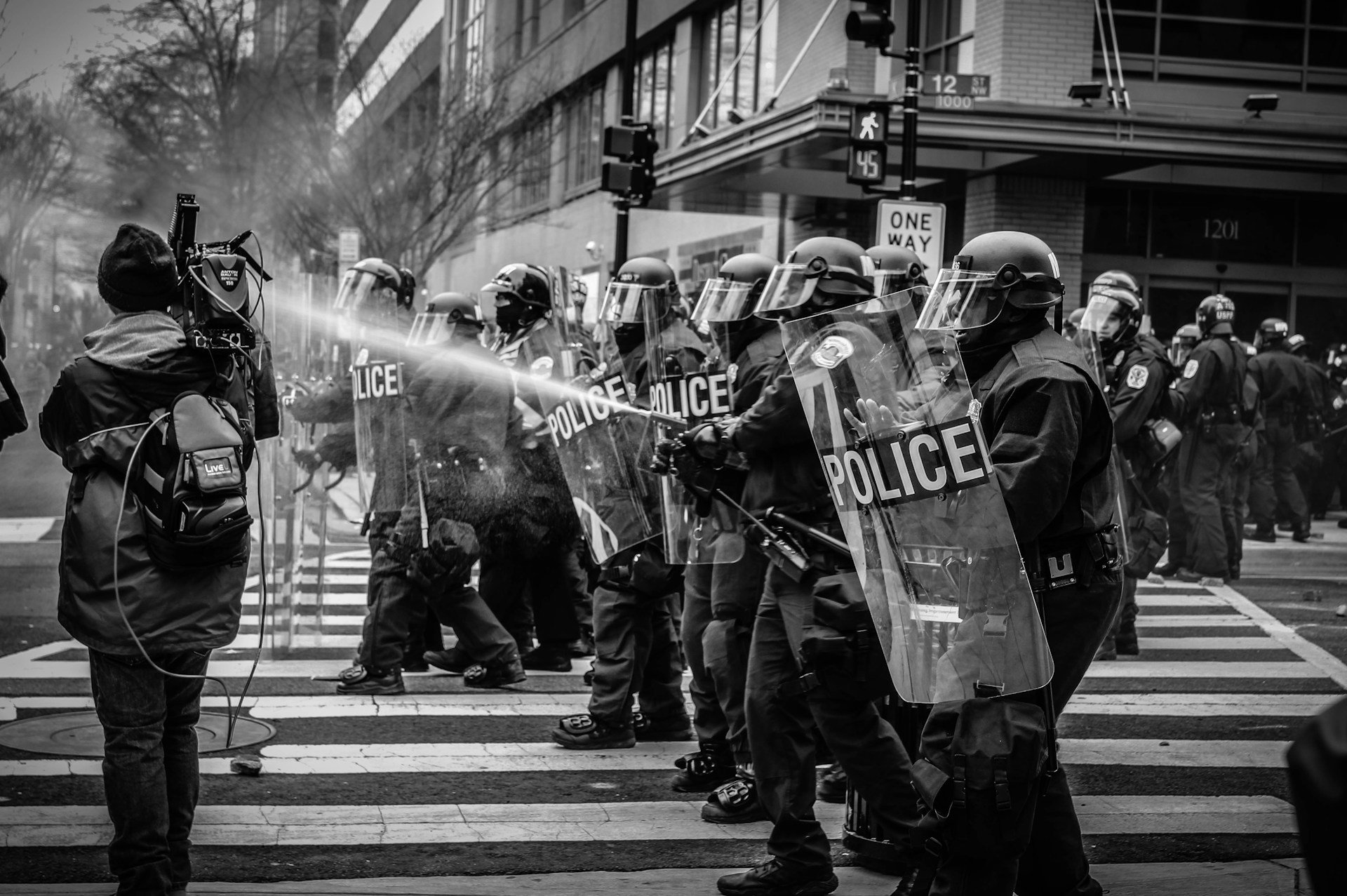
Recall again the summer of 2020. As I said, it has been officially remembered as a largely non-violent movement for racial reckoning that transformed corporate ad campaigns and institutional policies. In fact, it was the George Floyd Uprising. It began with the burning of a police station and, for about 3 weeks, this country experienced the largest wave of riots in its history, many of which targeted police cars and infrastructure, paralyzing the police’s ability to maintain order in multiple cities.
These few weeks at the beginning of the summer were not aberrations that can be written out of the history of that movement, nor were they actions that prevented the movement from becoming popular. Rather, they were the initial explosion of energy that dwindled as the movement became progressively more tame, less disruptive, and more guided by official nonprofits and demands for policy changes that could be won within existing institutions.
After 2020, there was a lull in Left social movements. A notable exception to this was the Stop Cop City campaign in Atlanta, which conceived itself as a continuation of that movement to prevent the construction of a new wave of police training facilities that aimed to reconstruct their public image.
But in the spring of 2024, encampments to stop the genocide in Palestine were created by students and activists at universities across the country. This movement too contributed to the process of education I am describing, teaching us that the US is still actively committed to supporting regimes conducting genocide. And that even our most “liberal” institutions are willing to self-destruct to prevent that truth from being uttered.
The intensity of the police response to the Palestinian solidarity movement suggests that a new kind of limit was hit by this movement. The commitment to supporting the state of Israel’s assault on Palestinians seems to run so deep that both political parties and University administrations around the country appeared to agree that it would be better to simply destroy freedom of speech on college campuses and slander people trying to oppose a genocide than to acknowledge the humanity of the Palestinian people.
Suddenly, on top of the insights described above, which were largely focused on unearthing the contours of domestic oppression, there was a direct focus on the implications of state, academic, and corporate institutions in US imperial policy. This meant that the movement’s basic moral insight simply could not be integrated into existing institutions as a new policy or training.
I know this is leaving a lot out. Any nutshell narrative of a decade plus is going to. But if you find this more or less plausible, then consider two points that I think provide some perspective on what it might mean to interrupt the plans currently being imposed upon us:
- First, what if we think of this cycle of movements as a process of collective education, a process of our digging beneath the illusions and unearthing the real history of the United States? Each of these movements demanded that we rethink who we are, developing a new framework to make sense of our own lives and actions. They were forces of memory that challenged the amnesia imposed upon us. This process is what might be meant by “progress” in the moral sense, in the sense of deepening popular education and changing common sense in a way that is more grounded in the reality of people’s lived experience and the operations of power.
- Second, if we have indeed arrived in a situation in which a dictatorship is emerging, and if that dictatorship relies on the power of the police to enforce its will, then it is worth remembering that we all have some memory of how the police can be obstructed from doing so. In the early Summer of 2020, we caught a glimpse of the ability for everyday people to paralyze the apparatus by which their will is imposed on us.
To summarize: I’m inviting you to understand what is happening today as not simply something that powerful people are doing to us powerless people. Rather, it is a counter-revolution that we have earned. Because our struggles for justice have been so effective at disrupting their political game, the ruling class of billionaires and their neo-fascist gurus have been forced to fundamentally change the rules in order to set us all back. Its like we have been winning the game so far, to the point where we have arrived at the Big Boss: fascist dictatorship, cultural counter-revolution, and a new apparatus of surveillance and policing. The Monster Con. That is the only roadblock they have left to stop a transformation of common sense from becoming an actual transformation of reality.
The Problem in their Model
I want to focus on one major tension that has constantly reemerged within this process I’ve sketched, which I think is the structural source of many of the others. Overcoming this tension will, for many of us, require another shift in perspective. But I think we are at a moment where the only chance to rise to the task means one more level of collective education. Because doing so allows us to see the major weakness within the Monster Con’s counter-revolution.
To see it, we have to acknowledge that in attacking what they call “wokeness,” they are in practice attacking the policies that have attempted to adapt existing institutions to the moral progress in common sense that I’ve described above: DEI policies, federal funding for health, science and critical thinking, climate justice, etc.
Now this reveals two perspectives that were always in an uncomfortable relation across the process I described. Let’s give them names:
- The Institutionalist perspective: From one perspective within the movements, the institutionalization of values is what progress looks like: demands that originate from moral outrage in the streets become codified in workplaces, policy, and law.
- The Counter Power perspective: From another perspective within the movements, these institutional forms of progress were always, at best, band-aids that didn’t really solve the problems — and at worst, they were ways of actually stopping the energy of social movements and maintaining the status quo. The change in policy and diversity in ‘seats at the table’ were a way of preventing genuine transformation from happening. In words I vividly recall from a clergy member speaking in St. Louis after having been tear-gassed in Ferguson, “we have been demanding inclusion into power, but the point should have been to dismantle the institutions of power itself.” The Counter Power perspective held that organizational forms to sustain moral progress — and the conditions of life itself — had to be built up at a distance from and in opposition to state-controlled institutions.
This tension has long existed within movements for social justice. Those working with existing institutions say the radicals in the streets aren’t being realistic — to be ‘realistic’ means to adapt lofty demands to existing powerful institutions and set progressively better standards within them.
But those in the streets always had a compelling response. They would say that it is this piecemeal progress that is, in fact, unrealistic: if you rely on state-supported institutions for moral progress, then it can all be erased the moment the winds of state power shift and blow in a different direction. Moreover, if you’ve built up the power of those institutions in the process — giving them more legislation, more police, more surveillance — then these institutions will be in a position to do even greater damage when the winds shift, as they inevitably will when the power of the ruling class is genuinely threatened.
Maybe things could have gone another way. Maybe progress within institutions could have been continually pursued without this backlash. But I think we have to admit that it hasn’t worked out that way for us. For better or worse, the street side of the argument has won, and we have to admit that progress can’t be trusted in the hands of institutions that are subject to state authority: it must be built and defended outside those institutions. I hope to elaborate on this theme in future posts.
So, at long last, we can get to the weak point in the ongoing Butterfly Revolution. Its this: if the street side is right, then the institutional forms progress has taken are not actually the threat those in power think they are. Rather, those policies of institutionalized wokeness are, in fact, the means by which the demands for change in the streets have been diverted and tamed in order to maintain the overall power structure. In attacking the institutionalized forms of moral progress, the techno and christian fascists are throwing out one of their own most powerful weapons for suppressing social movements. In directing their attacks at these institutions, they are in fact attacking their own shield.
Those institutional forms of managing demands from below were developed over decades, and for good reason. Should we recognize that our freedom — and everything else — is at stake, and should we choose freedom, they simply cannot hold their project together with violence and bullying alone.
But this will take a massive expression of disruption from below. We’ve seen what that looks like: something like the early weeks of the George Floyd Rebellion, but without any illusions of piecemeal demands.
The Challenge
In conclusion: A small group of billionaires, scared that the American people were moving in a direction that might actually challenge their power, have granted themselves permission to dream very big about the kind of world they want. They freed themselves from the boundaries of the American Constitution in order to set a course for a new organization of the political world. They have given themselves the right to act boldly to impose this new order on us, and they are not going to stop unless we find a way to stop them.
The question I think we are presented with is this: will the process of education won by social movements be able to take the next step together? Can we drop the illusion that moral progress, the fight for historical justice, and the fight for the future of life on the planet, can be achieved through policies of existing institutions, and give ourselves the right to directly build the future we deserve? Can we drop the bullshit and oppose the apparatus of rule like our lives and the lives of those we love are at stake? Because they are.
One way or another, we are inside a process of fundamentally changing the world. If we don’t want their plan to be the only one on offer, we have to similarly give ourselves the right to dream big, to act boldly, and make clear that its our vision against theirs.
Support and subscribe to The Now Times here.
Photo by ActionVance on Unsplash